



Parquetry Flooring
-
Grand Oak Chevron Collection Engineered Timber Balinese Oak
Price on request -
Grand Oak Chevron Collection Engineered Timber Black Opal
Price on request -
Grand Oak Chevron Collection Engineered Timber Gunsynd Oak
Price on request -
Grand Oak Chevron Collection Engineered Timber Mink Grey
Price on request -
Grand Oak Chevron Collection Engineered Timber Natural Oak
Price on request -
Grand Oak Chevron Collection Engineered Timber Parisien Grey
Price on request -
Grand Oak Chevron Collection Engineered Timber Raw
Price on request -
Herringbone European Oak
From $92.50 /m²




Parquetry flooring in Melbourne: herringbone and chevron
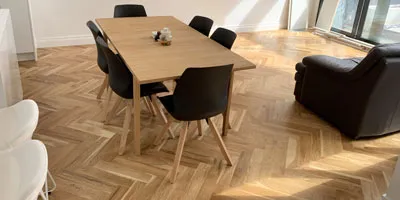
Parquetry, also called parquet flooring, is timber flooring laid in a repeating pattern instead of straight rows. The two patterns people ask for are herringbone, where rectangular blocks meet at right angles in a zigzag, and chevron, where the board ends are cut on an angle so each pair meets in a clean V. Greenhill Timbers supplies both from 170 Settlement Road, Thomastown, with pickup or delivery across Melbourne and regional Victoria.
What we stock
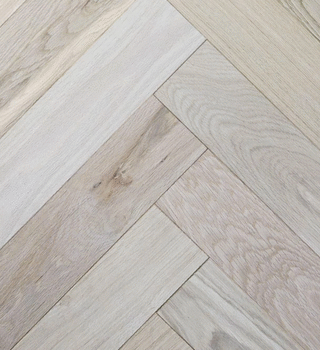
Herringbone European Oak: 18 mm European Oak herringbone blocks, pre-cut for the pattern with a tongue-and-groove joint and supplied raw, so you choose the stain and coating once the floor is down.
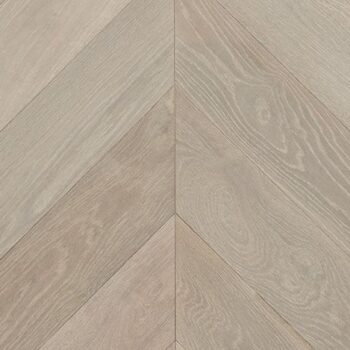
Grand Oak Chevron Collection by Australian Select Timbers: engineered chevron boards, 900 × 150 × 14.5 mm, with a 3 mm European Oak wear layer, a wire-brushed matte UV lacquer and bevelled edges. Each 1.35 m² pack holds six left-hand and six right-hand boards. Colours: Natural Oak, Raw, Parisien Grey, Mink Grey, Gunsynd Oak, Black Opal and Balinese Oak.
Herringbone in other floor types
Our 7 mm hybrid flooring comes in a 635 × 127 mm herringbone board as well as straight planks, in Hojicha, Lilac Grey, Filbert and White Haze: a waterproof-core option for kitchens and tighter budgets. Several of our European Oak engineered colours can also be ordered in herringbone or chevron, including Acorn Brown, Antique White, Natural Limed and Midnight Grey.
Laying parquetry
Pattern floors are cut at every wall, so allow about 15% for waste rather than the usual 10%. The subfloor has to be flat, because pattern joints show every hollow. Tongue-and-groove parquetry is glued to a flat, dry slab or sheet subfloor with a flexible flooring adhesive from flooring accessories, set out from a centre line so the pattern finishes evenly at both walls. Call 03 9465 9875 with the room sizes and we will work out packs.
Questions we get asked about parquetry flooring
What is the difference between herringbone and chevron?
Herringbone uses rectangular blocks laid at right angles, so each block butts into the side of the next and the pattern steps in a zigzag. Chevron boards have their ends cut on an angle, so each pair meets in a straight line and forms a clean V.
How much extra flooring does a herringbone floor need?
Allow about 15% over the room area. Every row is cut where it meets a wall, so pattern floors waste more than straight boards, where 10% is usual.
Can parquetry go over a concrete slab?
Engineered parquetry can, glued to a flat, dry slab with a flexible flooring adhesive and a moisture barrier where the slab needs one. Hybrid herringbone floats over underlay instead.
Does a herringbone floor cost more to lay?
Yes. Setting out the pattern and cutting in at every wall takes longer than laying straight boards, so allow for more labour as well as the extra waste.