



Melbourne Timber Decking Cost/Pricing Guide (2026)

If you’re planning a new deck this year, one of the first questions you’ll ask is simple: what does it actually cost? The honest answer is “it depends”, but that’s not much use when you’re trying to set a budget. This guide breaks down timber decking costs that Melbourne homeowners, builders, and renovators can expect in 2026, covering material prices by species and size, indicative installation costs, and the extra line items that often catch people out.
Prices below reflect current supply pricing at Greenhill Timbers and are intended as a general guide. Every project is different, so treat these figures as a starting point for planning rather than a fixed quote. Get in touch for project-specific pricing once you know your deck size and timber preference.
What Drives the Cost of Timber Decking?
A handful of core variables shape the cost of decking in Melbourne, and understanding them is the fastest way to build a realistic budget:
- Timber Species: Hardwoods like Merbau and Spotted Gum sit at different price points depending on density, appearance and how far they’ve travelled to reach the yard.
- Board Size & Profile: Wider boards (140mm) generally cost more per lineal metre than narrower ones (90mm), though they can cover a deck faster with fewer joins.
- Deck Size & Shape: Larger decks benefit from economies of scale, while irregular shapes with multiple angles increase both material wastage and labour time.
- Site Access: A backyard with easy access is cheaper to build on than a sloping block or a deck that requires materials to be carried through the house.
- Design Complexity: Multi-level decks, built-in seating, feature borders, and picture-framed edges all add time and material.
- Labour: Installation is typically quoted separately from materials and varies by installer, substructure requirements and finish level.
Timber Decking Cost
Here’s how popular timber decking species compare on cost in Melbourne, based on Greenhill Timbers’ current stock pricing. Actual coverage will vary slightly depending on board width, spacing and wastage allowance, so use these as indicative ranges rather than exact figures.
You will also see that the cost of timber decking is not measured in square metres but in lineal metres. This is because you’re essentially buying a length of raw material, and only once the boards are installed, with specific spacing and overlap, can a square metre figure be calculated. Pricing per lineal metre reflects what’s actually being purchased.
Please note that pricing changes frequently. The figures below reflect the most accurate available pricing at the time of writing.
Merbau Decking Cost Melbourne
Merbau decking is Melbourne’s most popular decking timber, and for good reason: it’s dense, rich in colour, relatively easy to work with, and sits at a genuinely accessible price point. At Greenhill Timbers, we stock a full range of Merbau decking, from 90mm to 190mm boards, with both random and set-length options so you can match the right size and budget to your build.
Cost Per Lineal Metre:
- 140 x 19 Random: $9.75/ L/M
- 140 x 19 Set Length: $7.95 – $76.38 / Piece
- 90 x 19 Random: $6 / L/M
- 90 x 19 Set Length: $5.30 – $49.02 / L/M
- 190 x 19 Set Lengths: $49.50 – $66 / Piece
Spotted Gum Decking Cost Melbourne
Spotted Gum decking is the go-to choice when bushfire compliance matters, thanks to its BAL rating, lighter tone, and strong dimensional stability.
Cost Per Lineal Metre: $9.60-$140.36/ L/M & Piece
Blackbutt Decking Cost Melbourne
Blackbutt decking is prized for its clean, even grain and is a common choice in bushfire-prone zones. The price difference is largely due to board grade – a standard grade sits at the lower end, while a premium feature grade pushes toward the top.
Cost Per Lineal Metre: From $10.36-$19.90 / L/M
Silvertop Ash Decking Cost Melbourne
Silvertop Ash is a naturally durable hardwood that withstands the state’s shifting weather without excessive movement, making it a solid mid-to-premium option for exposed decks.
Cost Per Lineal Metre: $8.95-$17.50 / L/M
Ironbark Decking Cost Melbourne
Ironbark is the densest and longest-lasting timber in the range. It’s heavier and harder on tools during installation, but that density is exactly what gives it such a long service life, a good pick if longevity matters more to you than upfront cost or ease of handling.
Cost Per Lineal Metre: $10.62 – $15.90 / L/M
Treated Pine Decking Cost Melbourne
At Greenhill Timbers, we stock both surface- and structural-treated pine, so it’s worth knowing which you’re pricing up. It’s a genuinely budget-friendly option either way, though most Melbourne decks still pair structural treated pine underneath with a hardwood surface on top for appearance and feel underfoot.
Cost Per Lineal Metre (Structural):
- Treated Pine 90 x 45 MGP10 HS LOSP: $7.43 – $44.58 / Piece
- Treated Pine 140 x 45 MGP1- H3 LOSP: $10.35 – $62.10 / Piece
- Treated Pine 190 x 45 MGP1- H3 LOSP: $13.82 – $82.92 / Piece
- Treated Pine 240 x 45 MGP10 H3 LOSP: $19.41 – $116.46 / Piece
- Treated Pine 70 x 45 MGP10 H3 LOSP: $5.56 – $33.36 / Piece
Cost Per Lineal Metre (Surface)
- Lowdeck Gl8 H4 88 x 44mm Treated Pine: $80.60 / Each
- Lowdeck Gl8 H4 138 x 44mm Treated Pine: $136.86 / Each
Material Costs vs Installation Costs
It’s easy to conflate the two, but they’re separate line items. The figures above cover the cost of timber decking boards themselves, priced by length, width and grade. To calculate the actual cost to build a timber deck in Melbourne, you must combine the material costs with installation and labour fees.
Installation is quoted independently by your builder or decking installer and typically reflects:
- Labour hours and crew size
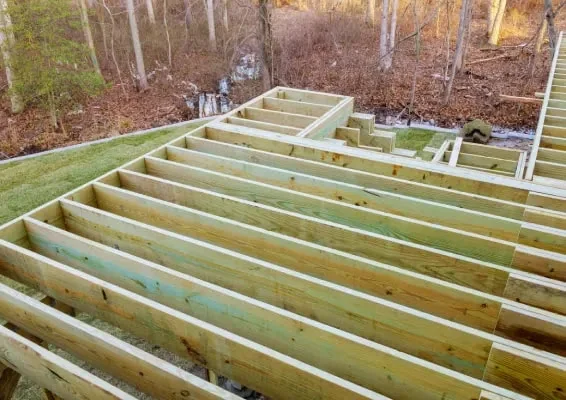
- Substructure work (bearers, joists, footings)
- Site conditions and access
- Fixing method (screwed, hidden clip systems, etc.)
Melbourne installation rates vary widely depending on the installer and project complexity, so it’s worth getting a written quote from a licensed decking builder once your design is set. If you’d like a hand finding one, Greenhill Timbers can connect you with trusted installers experienced with our timber.
What Else Adds to the Cost?
When people ask “How much does timber decking cost in Melbourne?”, they’re often only picturing the boards. A full project usually includes:
- Framing & Substructure: Bearers, joists and blocking, often in treated pine or hardwood.
- Footings & Stumps: Concrete or steel, depending on deck height and soil conditions.
- Stairs & Balustrades: Required by code for decks above a certain height, and priced separately from the deck surface.
- Permits: Larger or elevated decks may require council approval or a building permit.
- Fixings: Stainless steel screws or hidden fastening systems, which cost more than standard screws but reduce splitting and staining.
Surface Finishing: Oil, stain or decking oil to protect the timber and bring out its colour.
Leaving these out of your budget is one of the most common reasons project costs come in higher than expected.
How to Reduce Costs Without Cutting Corners
If you’re working to a cost to build a timber deck your Melbourne budget won’t quite stretch to, there are sensible ways to bring the number down:
- Choose a mid-range hardwood like Merbau over a premium species if appearance is a lower priority than durability.
- Simplify the design – fewer angles, levels and custom features mean less labour and less wastage.
- Right-size the substructure – don’t over-engineer footings beyond what’s structurally required.
- Buy set lengths where possible to reduce offcuts and wastage.
- Stick to standard board widths (90mm or 140mm) rather than specialty profiles.
What we’d avoid cutting is fixings, timber grade for structural elements, and proper substructure – these affect the safety and lifespan of the deck, and false savings here tend to cost more in repairs down the track.
Choosing Timber for Melbourne's Climate
Melbourne’s weather swings between hot, dry summers and wet winters, which puts real demands on decking timber. Boards need to cope with expansion and contraction, particularly where airflow underneath the deck is limited. Kiln-dried hardwood decking is the standard for this reason; it reduces warping and shrinkage once installed, though some movement in the first few months is normal as the timber settles.
Species like Spotted Gum and Silvertop Ash are well suited to Victorian conditions thanks to their natural stability. At the same time, denser timbers like Ironbark offer maximum longevity for decks that will see heavy use or full sun exposure.
Planning Your Decking Budget
Between timber species, board size, substructure, fixings, finishing, and installation, a Melbourne deck project has more moving parts than the sticker price on a single board suggests. The most reliable way to budget is to start with your deck size and preferred timber, then build outward from there: materials, substructure, labour, and finishing.
Browse our full range of timber decking options, or request a personalised quote and our team will help you plan a deck that fits your budget and your block.